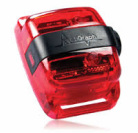
Physical Activity Monitor Research
A key focus in our lab is on improving the validity and utility of measures of physical activity and considerable work is aimed at the use of accelerometry-based activity monitors. Some specific lines of research are summarized below and on the associated pages.
Overview of Accelerometry-Based ResEaRch
A key area of work in our lab is focused on improving the accuracy and utility of physical activity assessments. Our lab has conducted a range of validity and reliability studies and has contributed to guiding best practices in the field for processing and interpreting data from accelerometry - based monitors. A list of papers led by members of our team is included here but we have active collaborations with a number of other colleagues that conduct similar work.
Bodymedia Sensewear ArmbandOur lab conducted pioneering work with the SenseWear armband monitor which utilized multiple heat detecting sensors in addition to a tri-axial accelerometer to assess physical activity, The multi-sensor configuration and pattern recognition methods developed by Bodymedia provided advantages over other competing technologies. We conducted foundational research with the Sensewear and contributed to algorithm evaluation and refinement. We documented the advantages of this technology over other monitors using the doubly-labelled method as well as with portable indirect calorimetry methods. The Sensewear became accepted as perhaps the most valid research grade tool. While it is no longer commercially available, our lab still uses it in studies as a de-facto "alloyed standard" for comparisons with other monitors and assessments.
Evaluation of Consumer-Based Monitoring DevicesOur team has contributed to advancing research on the accuracy and utility of many consumer - based activity monitors. Early research compared the accuracy of different monitors - most of which are not commercially available anymore (e.g. FitBit (Force / Flex), Direct Life, Nike Fuelband, Jawbone UP, Basis, Larklife, Garmin VivoFit, Magellan Echo, Mio Alpha, Misfit Shine, Polar Loop etc...). Click here for more info.
Work with consumer monitors has evolved to focus more on Smartwatches and we are continuing to do this work through our FLASH project. See the link on the FLASH Project for more information. Calibration of Report-Based MeasuresOur lab has conducted pioneering research on measurement error in physical activity self-report and has advanced applications for calibration methods to improve the accuracy and utility of report-based measures.
Emphasis in the field has been on refining the accuracy and utility of monitor-based methods for estimating energy expenditure (EE) and time spent in moderate to vigorous physical activity (MVPA) or sedentary behavior (SB). The objectivity of monitor-based measures is a considerable advantage, but report-based tools are more practical and provide valuable information about the context of physical activity behavior. Thus, our approach has been to try to harmonize the methods to capitalize on the strengths of both approaches. Click here to access a list of papers on report-based measures or see the information below about specific calibration-based work. Access to R Code files
Our lab supports open-source processing methods and will be working to post updates on our data processing methods online so that they can be easily accessed and used. Click here for more info.
|
Published Research
Calibration of Self-Report Measures
The refinement of methods for processing monitors-based data is central to our related research on calibration of report-based measures. This work is most actively applied in the development and refinement of the Youth Activity Profile (see link)
|